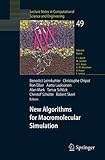
Molecular simulation is a widely used tool in biology, chemistry, physics and engineering. This book contains a collection of articles by leading researchers who are developing new methods for molecular modelling and simulation. Topics addressed here include: multiscale formulations for biomolecular modelling, such as quantum-classical methods and advanced solvation techniques; protein folding methods and schemes for sampling complex landscapes; membrane simulations; free energy calculation; and techniques for improving ergodicity. The book is meant to be useful for practitioners in the simulation community and for those new to molecular simulation who require a broad introduction to the state of the art.
Friday, June 5, 2009
New Algorithms for Macromolecular Simulation (Lecture Notes in Computational Science and Engineering)
New Algorithms for Macromolecular Simulation (Lecture Notes in Computational Science and Engineering)

Computational Probability: Algorithms and Applications in the Mathematical Sciences
Computational Probability: Algorithms and Applications in the Mathematical Sciences (International Series in Operations Research & Management Science)

Computational probability encompasses data structures and algorithms that have emerged over the past decade that allow researchers and students to focus on a new class of stochastic problems. COMPUTATIONAL PROBABILITY is the first book that examines and presents these computational methods in a systematic manner. The techniques described here address problems that require exact probability calculations, many of which have been considered intractable in the past. The first chapter introduces computational probability analysis, followed by a chapter on the Maple computer algebra system. The third chapter begins the description of APPL, the probability modeling language created by the authors. The book ends with three applications-based chapters that emphasize applications in survival analysis and stochastic simulation.
The algorithmic material associated with continuous random variables is presented separately from the material for discrete random variables. Four sample algorithms, which are implemented in APPL, are presented in detail: transformations of continuous random variables, products of independent continuous random variables, sums of independent discrete random variables, and order statistics drawn from discrete populations.
The APPL computational modeling language gives the field of probability a strong software resource to use for non-trivial problems and is available at no cost from the authors. APPL is currently being used in applications as wide-ranging as electric power revenue forecasting, analyzing cortical spike trains, and studying the supersonic expansion of hydrogen molecules. Requests for the software have come from fields as diverse as market research, pathology, neurophysiology, statistics, engineering, psychology, physics, medicine, and chemistry.
Handbook of Algorithms for Wireless Networking and Mobile Computing (Chapman & Hall/Crc Computer & Information Science)
Handbook of Algorithms for Wireless Networking and Mobile Computing (Chapman & Hall/Crc Computer & Information Science)
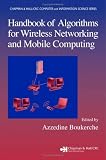
Handbook of Algorithms for Wireless Networking and Mobile Computing (Chapman & Hall/Crc Computer & Information Science)
Most of the available literature in wireless networking and mobile computing concentrates on the physical aspect of the subject, such as spectrum management and cell re-use. In most cases, a description of fundamental distributed algorithms that support mobile hosts in a wireless environment is either not included or is only briefly discussed. Handbook of Algorithms for Wireless Networking and Mobile Computing focuses on several aspects of mobile computing, particularly algorithmic methods and distributed computing with mobile communications capability. This volume provides the topics that are crucial for building the foundation for the design and construction of future generations of mobile and wireless networks, including cellular, wireless ad hoc, sensor, and ubiquitous networks. Following an analysis of fundamental algorithms and protocols, the book offers a basic overview of wireless technologies and networks and a discussion of the convergence of communication and computation. Other topics include issues related to mobility, with a focus on the creation of techniques that control associated uncertainties; aspects of QoS provisioning in wireless networks; a comparison of numerous wireless TCP proposals; a review of fundamental algorithms for Bluetooth wireless personal area networks (WPANs); and investigations of future voice and video access networks; and a review of potential applications of pervasive computing and mobile e-commerce.
Customer Review: timely summary of methods in this field
In typical CRC fashion, this book offers a good summary of its field. There is an authoritative treatment of the key algorithms in wireless nets or for mobile computing. The book brings together the equivalent of centuries of person-years in research and development.
The methods in the book are basically state of the art. At least as far as publicly revealed methods are concerned.
The field is still undergoing active development. The book discusses how quality of service issues are currently handled. One area worthy of improvement.
Thursday, June 4, 2009
Algorithms and Data Structures: Design Correctness Analysis (International computer science series)
Algorithms and Data Structures: Design Correctness Analysis (International computer science series)
Algorithms and Data Structures: Design Correctness Analysis (International computer science series)
Customer Review: Advance, Useful, Helpful
If you are a computer science student or advance programmer, you should get this book. The diagrams and descriptions in the book give you insights of the advance programming which would help you. However you may get confused because the examples in the book is using the programming language Eiffel. You would like this book if and only if you like hard coding.
Numerical Simulation in Molecular Dynamics: Numerics, Algorithms, Parallelization, Applications (Texts in Computational Science and Engineering
Numerical Simulation in Molecular Dynamics: Numerics, Algorithms, Parallelization, Applications (Texts in Computational Science and Engineering)

Particle models play an important role in many applications in physics, chemistry and biology. They can be studied on the computer with the help of molecular dynamics simulations. This book presents in detail both the necessary numerical methods and techniques (linked-cell method, SPME-method, tree codes, multipole technique) and the theoretical background and foundations. It illustrates the aspects modelling, discretization, algorithms and their parallel implementation with MPI on computer systems with distributed memory. Furthermore, detailed explanations are given to the different steps of numerical simulation, and code examples are provided. With the description of the algorithms and the presentation of the results of various simulations from the areas material science, nanotechnology, biochemistry and astrophysics, the reader of this book will be able to write his own programs for molecular dynamics step by step and to run successful experiments.
Algorithms in Combinatorial Geometry (Monographs in Theoretical Computer Science : an EATCS Series)
Algorithms in Combinatorial Geometry (Monographs in Theoretical Computer Science : an EATCS Series)

Algorithms in Combinatorial Geometry (Monographs in Theoretical Computer Science : an EATCS Series)
Product Description
This book offers a modern approach to computational geo- metry, an area thatstudies the computational complexity of geometric problems. Combinatorial investigations play an important role in this study.
Monday, June 1, 2009
Combinatorial Algorithms for Computers and Calculators (Computer science and applied mathematics)
Combinatorial Algorithms for Computers and Calculators (Computer science and applied mathematics)
Combinatorial Algorithms for Computers and Calculators (Computer science and applied mathematics)
Excerpts from the Introduction:
This book can be read at several levels. Those whose only need is to use one of the computer programs can turn immediately to those pages and satisfy their wants. Thus, on one level, this is a collection of subroutines, in FORTRAN, for the solution of combinatorial problems.
At the other extreme, pure mathematicians with no need of computer programs will find much that is new and hopefully interesting in these pages. For example, in the special section Deus ex Machina (pp. 78-87), the random selection algorithms of Chapters 10, 12, and 29 are shown to be manifestations of a general phenomenon which sheds light on a number of seemingly unrelated threads of research in combinatorial analysis.
Between these two extremes is a rapidly growing category of (frequently youthful) persons who have access to a fancy calculator (hand-held or table-top). They may not be interested in either the de tailed mathematics or the FORTRAN programs - yet we hope they will find much to stimulate them and help them prepare their own programs.
Our hope, however, is that many readers will want to follow the entire road from general mathematics to particular mathematics to informal algorithm to formal algorithm to computer program and back again, which occurs in virtually every chapter of the book.
Our other hope is that readers will view these methods and programs as a beginning set of building blocks for their own kit of tools and will go on to add to these tools to meet their own needs, so that the contents of this book will be not a collection of pretty artifacts to be looked at but basic elements of the growing and working equipment of scientific investigation and learning.
Handbook of Bioinspired Algorithms and Applications (Chapman & Hall/Crc Computer & Information Science)
Handbook of Bioinspired Algorithms and Applications (Chapman & Hall/Crc Computer & Information Science)

Handbook of Bioinspired Algorithms and Applications (Chapman & Hall/Crc Computer & Information Science)
The mystique of biologically inspired (or bioinspired) paradigms is their ability to describe and solve complex relationships from intrinsically very simple initial conditions and with little or no knowledge of the search space. Edited by two prominent, well-respected researchers, the Handbook of Bioinspired Algorithms and Applications reveals the connections between bioinspired techniques and the development of solutions to problems that arise in diverse problem domains. A repository of the theory and fundamentals as well as a manual for practical implementation, this authoritative handbook provides broad coverage in a single source along with numerous references to the available literature for more in-depth information. The book's two sections serve to balance coverage of theory and practical applications. The first section explains the fundamentals of techniques, such as evolutionary algorithms, swarm intelligence, cellular automata, and others. Detailed examples and case studies in the second section illustrate how to apply the theory in actually developing solutions to a particular problem based on a bioinspired technique. Emphasizing the importance of understanding and harnessing the robust capabilities of bioinspired techniques for solving computationally intractable optimizations and decision-making applications, the Handbook of Bioinspired Algorithms and Applications is an absolute must-read for anyone who is serious about advancing the next generation of computing.
Customer Review: Handbook of Bioinspired Algorithms and Applications
I am using the book now for class work. I find it easy to read and comprehensible.
Algorithms & Data Structures: The Science Of Computing (Electrical and Computer Engineering Series)
Algorithms & Data Structures: The Science Of Computing (Electrical and Computer Engineering Series)

Algorithms & Data Structures: The Science Of Computing (Electrical and Computer Engineering Series)
While many computer science textbooks are confined to teaching programming code and languages, Algorithms and Data Structures: The Science of Computing takes a step back to introduce and explore algorithms -- the content of the code. Focusing on three core topics: design (the architecture of algorithms), theory (mathematical modeling and analysis), and the scientific method (experimental confirmation of theoretical results), the book helps students see that computer science is about problem solving, not simply the memorization and recitation of languages. Unlike many other texts, the methods of inquiry are explained in an integrated manner so students can see explicitly how they interact. Recursion and object oriented programming are emphasized as the main control structure and abstraction mechanism, respectively, in algorithm design. Designed for the CS2 course, the book includes text exercises and has laboratory exercises at the supplemental Web site.
Customer Review: A good mix of programming and algorithms design
Algorithm and Algorithm design is a difficult topic to talk about or to learn. It is probably one of the most complex topics in the field of Computer Science and Mathematics, mostly due to its abstractness. Proof after proof, theory after theory, and complex mathematical expressions make the topic very difficult to grasp at times. The authors of Algorithms and Data Structures have taken this notion into account, and wrote this book in such a way that a Computer Science major student can relate popular programming and problems that we come across everyday to the notion of algorithm and complexity. The Java programming language is utilizes throughout the book, and the authors, D. Bladwin and G. W. Scragg, write pseudo-Java-code to demonstrate how, for example, various versions of the quicksort algorithm are coded. Programming is obviously not the focus of this book, but the code snippets are certainly a good teaching aid for the novice readers.
The book starts off with the basic ground work surrounding algorithms: what is a proof? Computer Science, Mathematics and theory, etc.. It basically answers the question why anyone should bother learning about algorithms and the complexity that surrounds this topic. The authors then take a rather unique approach to the theory behind algorithms by discussing program recursion and iteration. It seems a little odd, but it turns out to be a very good way to introduce readers to topic algorithms. Recursions is a topic covered in CS1 courses, and using that as the basis and introduction to algorithm design and correctness proof really reels in the reader and makes the topic easier to grasp.
After discussing algorithms basics, and showing the readers what algorithm efficiency, etc is, the authors take on the second part of the book which covers the data structures aspects of things. List, Queues, Stacks, Trees, etc... are all covered in detail. Algorithms that were discussed earlier in the text are applied to the data structures, and the complexity of each algorithm is actually depicted thru examples, pseudocode, and followed by its mathematical analysis. The text, in general, is focused around the concept of objects, abstract data types, and core object orientation techniques, and the presented material is targeted as such.
Towards the end of the text, the authors give the readers a brief but concise overview what's to come. Topics such as complexity, the undecideability, nondeterminism and the surrounding problems such as the HALTing problem, the Traveling Salesman Problem, etc... are touched. The authors pose some very interesting questions for the readers in the context of the HALTing problem as it pertains to complier design. These problems in their general form are unsolvable, and the authors make a very good case on why we care about such problems and issues.
In addition to being a very easy text read, the authors have filled each chapter with sample problems, examples, and techniques. For the second year computer science student, or a professional interested in the field of algorithm design and complexity analysis, I highly recommend reading this text.
Customer Review: College level computer science textbook
"Algorithms and Data Structures: The Science of Computing" is designed as a second course computer science textbook for colleges. At this level most computer sciences classes tend to focus on programming and programming theory. While it does have some programming examples (all in Java), this book takes a more overall view and deals with the basics of algorithms and data structures. Why is this an important difference? I have seen a lot of bloated code over the years where a programmer writes a hundred or more lines of code to do something that a couple of lines could do if they only had a better understanding of algorithms. This course gives you the conceptual knowledge you need to be able to adapt to other computer languages and coding techniques as they are developed.
The book does make some assumptions about the reader. First, it assumes the reader has had an introductory course in an object-oriented programming language. As indicated earlier, all examples are in Java, but you should be able to follow along if you have had a course in any object-oriented language. Second, the book also assumes a good (but not necessarily college level) background in mathematics.
This is a foundational course in the design of algorithms, and data structures and mathematical theory to predict and verify, as well as empirical analysis to test the results. "Algorithms and Data Structures: The Science of Computing" is a recommended book as a second course in a computer sciences degree as well as a foundational course for those who are trying to develop a broad basis of computer knowledge at home.
Sunday, May 31, 2009
Propositional Logic: Deduction and Algorithms (Cambridge Tracts in Theoretical Computer Science)
Propositional Logic: Deduction and Algorithms (Cambridge Tracts in Theoretical Computer Science)
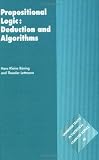
Propositional Logic: Deduction and Algorithms (Cambridge Tracts in Theoretical Computer Science)
This introduction to classical logic emphasises computational aspects. The authors treat issues of complexity and algorithmic analysis that have traditionally not been considered the realm of mathematical logic, but which are vital in areas such as automated reasoning, knowledge engineering, logic programming and AI.In order to make the book suited for teaching and for self-study, the book includes a systematic account of theoretical results, as well as an exposition of those appropriate algorithms which incorporate them.
Cellular Genetic Algorithms (Operations Research/Computer Science Interfaces Series)
Cellular Genetic Algorithms (Operations Research/Computer Science Interfaces Series)

Cellular Genetic Algorithms (Operations Research/Computer Science Interfaces Series)
Cellular Genetic Algorithms defines a new class of optimization algorithms based on the concepts of structured populations and Genetic Algorithms (GAs). The authors explain and demonstrate the validity of these cellular genetic algorithms throughout the book. This class of genetic algorithms is shown to produce impressive results on a whole range of domains, including complex problems that are epistatic, multi-modal, deceptive, discrete, continuous, multi-objective, and random in nature. The focus of this book is twofold. On the one hand, the authors present new algorithmic models and extensions to the basic class of Cellular GAs in order to tackle complex problems more efficiently. On the other hand, practical real world tasks are successfully faced by applying Cellular GA methodologies to produce workable solutions of real-world applications. These methods can include local search (memetic algorithms), cooperation, parallelism, multi-objective, estimations of distributions, and self-adaptive ideas to extend their applicability.
The methods are benchmarked against well-known metaheuristics like Genetic Algorithms, Tabu Search, heterogeneous GAs, Estimation of Distribution Algorithms, etc. Also, a publicly available software tool is offered to reduce the learning curve in applying these techniques. The three final chapters will use the classic problem of “vehicle routing” and the hot topics of “ad-hoc mobile networks” and “DNA genome sequencing” to clearly illustrate and demonstrate the power and utility of these algorithms.
Algorithms (Addison-Wesley series in computer science)
Algorithms (Addison-Wesley series in computer science)
Algorithms (Addison-Wesley series in computer science)
Customer Review: Good introductory text
I found this book at a university book shop back when I was 14 years old and bought it to learn more about certain algorithms. The reason I bought it was because it looked like it would provide very concrete advice on how to achieve an implementation while not requiring more advanced mathematics than I knew at the time.
Now, many years later I have to say that I can't think of any algorithm book I've come across that manages to balance theory and concrete solutions so well; and I own quite a few books on algorithms. (Some might object to the fact that the book uses Pascal as the implementation language, but I think I've seen this book tailored for other languages too).
Also, for a general book on algorithms, Sedgewick managed to pick a very good mix of topics to cover. According to a friend of mine (whom happens to know Sedgewick personally), the book just represents a cross-section of what Sedgewick himself was interested in.
This book was very useful to me when I was a teenager starting to understand bread and butter algorithms, and it continues to be a good reference still to this day. I would recommend you buy this book if you need a good book on fundamental algorithms.
(Also, the typography is very sober and clean, and the illustrations to most of the problems are very clear)
Customer Review: A classic when looking for information about algorithms
When having to solve problems regarding algorithms, this book is one of the frequently used books. It shows besides the interesting details also the larger overview, which certainly adds to your better understanding.
Learning to Classify Text Using Support Vector Machines: Methods, Theory and Algorithms (The Springer International Series in Engineering and Computer
Learning to Classify Text Using Support Vector Machines: Methods, Theory and Algorithms (The Springer International Series in Engineering and Computer Science)
Customer Review: The Gold standard
This is a must read for anyone beginning to investigate the analysis of meaning in text using computational methods. I found the initial sections were useful in bringing together my thought on many different aspects of the topic.
Customer Review: Wonderful book on the subject
This is a Tesis Work, it contains a review and conmparation of several learners. It focuses mainly on SVM.

Text Classification, or the task of automatically assigning semantic categories to natural language text, has become one of the key methods for organizing online information. Since hand-coding classification rules is costly or even impractical, most modern approaches employ machine learning techniques to automatically learn text classifiers from examples. However, none of these conventional approaches combines good prediction performance, theoretical understanding, and efficient training algorithms.
Based on ideas from Support Vector Machines (SVMs), Learning To Classify Text Using Support Vector Machines presents a new approach to generating text classifiers from examples. The approach combines high performance and efficiency with theoretical understanding and improved robustness. In particular, it is highly effective without greedy heuristic components. The SVM approach is computationally efficient in training and classification, and it comes with a learning theory that can guide real-world applications.
Learning To Classify Text Using Support Vector Machines gives a complete and detailed description of the SVM approach to learning text classifiers, including training algorithms, transductive text classification, efficient performance estimation, and a statistical learning model of text classification. In addition, it includes an overview of the field of text classification, making it self-contained even for newcomers to the field. This book gives a concise introduction to SVMs for pattern recognition, and it includes a detailed description of how to formulate text-classification tasks for machine learning.
Learning To Classify Text Using Support Vector Machines is designed as a reference for researchers and practitioners, and is suitable as a secondary text for graduate-level students in Computer Science within Machine Learning and Language Technology.
Customer Review: The Gold standard
This is a must read for anyone beginning to investigate the analysis of meaning in text using computational methods. I found the initial sections were useful in bringing together my thought on many different aspects of the topic.
Customer Review: Wonderful book on the subject
This is a Tesis Work, it contains a review and conmparation of several learners. It focuses mainly on SVM.
Subscribe to:
Posts (Atom)
